
|
|
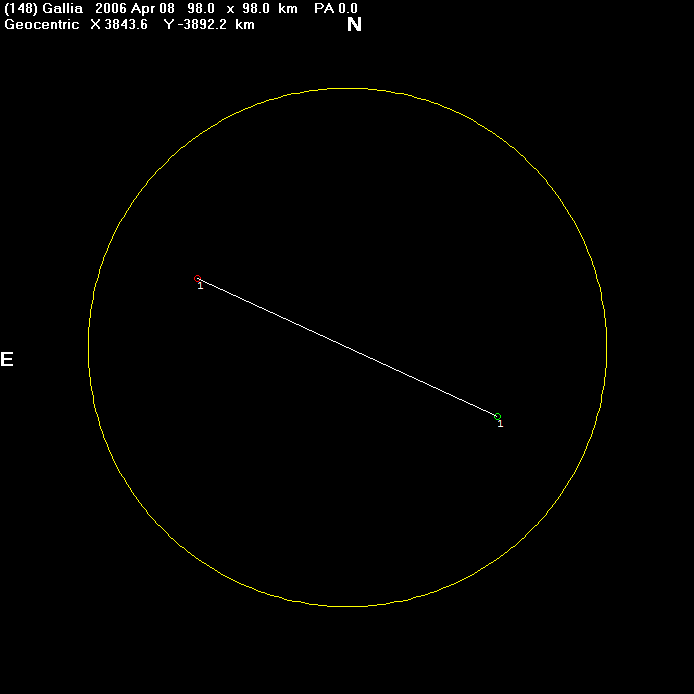
A 2.93 second occultation was recorded by John Broughton at Reedy Creek, Qld, Australia, using the CCD drift-scan technique.
View the updated prediction.
Observers:
  1    J. Broughton, Reedy Crk, Australia
Discussion:
The circle above is plotted at the expected 98km diameter of Gallia. With only one chord it is not possible to determine whether John was north or south of the central line of the event. However, assuming the updated prediction was approximately correct would suggest that the chord might lie across the southern portion of the asteroid.
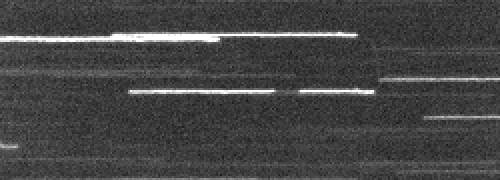
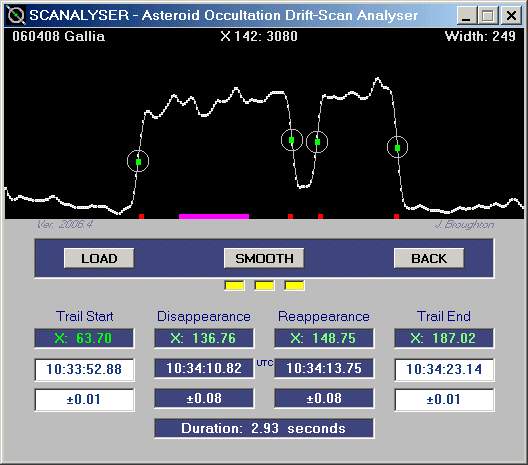
The figures below show the drift-scan image of the occultation together and the data as analysed by John's Scanalyser software.
Observational Data:
Observer's Name                  : John Broughton
Aperture (cm)                    : 50.1
Focal length (cm)                : 138
Type (e.g. SCT; Newtonian)       : F/2.7 modified newtonian
Magnification                    : CCD drift-scan at 4.1 pps, 60'FOV
Observing site name              : Reedy Creek, Gold Coast
Longitude (East +ve)             : +153 23' 49"
Latitude (South -ve)             : -28 06' 36"
Height above Sealevel (metres)   : 66
Geodetic Datum (e.g.WDD84,NZ1949): AGD66
Sky Transparency (Delete two)    : Fair
Star Image Stability (Delete two): Fair
Other Conditions:                  Gibbous moon at 38 deg. distance.
Time Source (e.g. WWV, VNG)      : WWVH.
Recording method (e.g. tape)     : Reel-to-reel tape recorder.
Could you see the Asteroid?      : Only combined light monitored though
                                   asteroid is visible during occultation.
Approx. Limiting Magnitude       : 13.5
                                          | Estimated  |
                           Universal Time | Reaction   | Accuracy, Remarks
                              h  m  s     | Time (sec) |
Started Observing          : 10:33:52.88       n/a       0.01
Disappearance At           : 10:34:10.82       n/a       0.08
Reappearance At            : 10:34:13.75       n/a       0.08
Stopped Observing          : 10:34:23.14       n/a       0.01
Duration                   :        2.93

ADDITIONAL COMMENTS:
Rigorously timed CCD drift-scan measured in Scanalyser as described here:
http://www.users.bigpond.com/reedycrk/driftscantiming.htm

Scantracker enabled a blind positioning of the telescope during daylight
hours to confirm the target was within the telescope's limited range of
motion. The same software can predict when bright stars will cross the
field of the stationary telescope closer to the event as confirmation
of the pointing.

The occultation exposure was limited to 30 seconds due to a high risk
that encroaching cirrus illuminated by the moon would spoil the image.
Fortunately line-of-sight cloud was relatively light at the critical time.