ASTROMETRIC UPDATE:
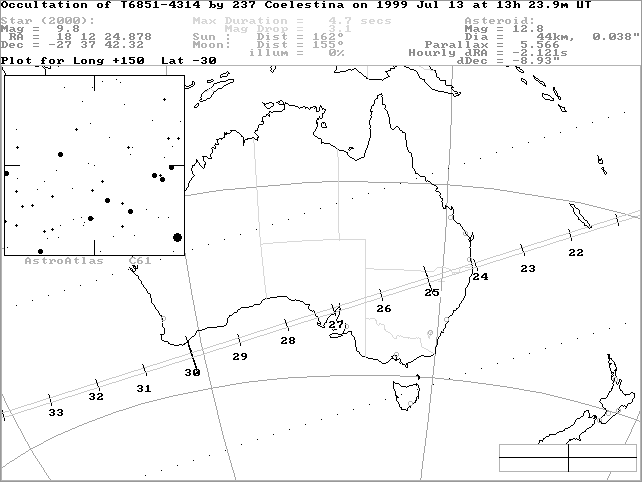
OCCULTATION BY (237) COELESTINA - 1999 JULY 13
CHECK THIS PAGE REGULARLY FOR FURTHER UPDATES AND CHANGES TO THE TRACK.
YOU MUST RELOAD THIS PAGE USING YOUR BROWSER'S
RELOAD/REFRESH BUTTON TO OBTAIN UPDATES!
[Prediction using OCCULT software]
The Goffin prediction (not available on the website) gives a path across central Australia.
The OCCULT path is in accord with this.
UPDATE: 8 July 1999
This prediction update has been computed by Graham Blow based upon 7 astrometric position of the planet obtained by Ron Stone (USNO/Flagstaff) between June 13 and July 5. Reduction is against the GSC position of the star using OCCULT software.
Summary:
The update astrometry moves the path approximately one track-width south. The updated track crosses Brisbane and the region of Adelaide.
Event time is about 2.5 minutes later than the nominal OCCULT prediction.
NOTE THE THE ERROR BARS ON THIS UPDATE ARE VERY LARGE. The updated track should not be regarded with any degree of certainty.
Approx time for Brisbane: 13h 24m UT
Approx time for Adelaide: 13h 27m UT
THE EVENT AT ONE GLIMPSE:
- Date and approx. UT time of event: July 13, 1999 @ 13:24 UT
- Magnitude of target star: 9.75
- Magnitude drop [mag]: 3.1
- Estimated maximum duration [s]: 4.7
- Path description: Path runs across Australia from Brisbane to Adelaide.
Data for the target star:
- Name: TYC 6851 04314
- J2000 position [h,m,s; o,',"]: 18h 12m 24.878s; -27o 37' 42.32"
- Position source: ACT
- V mag [mag]: 12.81
- Remarks:
Data for the minor planet:
- Number, name: (237) Coelestina
- Approx. diameter [km]: 44
- Source of used astrometry: USNO
- Number of used observations: 7
Data for the event:
- UT date and time of least geocentric approach: 13:23.9 UT
- Approx. V mag of minor planet at event [mag]: 12.81
- Geocentric parallax of minor planet ["]: 5.57
- Apparent motion of minor planet ["/h]: 29.57
- Magnitude drop [mag]: 3.1
- Estimated maximum duration [s]: 4.7
- Angular distance to moon, phase of moon [deg,%]: 155, 0%
IMPORTANT NOTE!
Astrometric updates such as these should not be taken as definitive, but rather only as an indication of where the true track may lie relative to the original predicted track. Observers must bear in mind that later astrometry, in which the target star is measured in the same field as the asteroid, may still reveal substantial changes to the predicted track and time of the event. For this reason it is most important that observers far from the predicted track still monitor the event.
Use these links for further information:
[Planetary Occultations]
[Using the Predictions]
[Observing Details]
[Timing Details]
[Reporting Details]
[Report Form]
[Asteroid Occultation Results]
This page may have been updated since 8 July 1999.
Hit your browser's RELOAD button to get the latest version.
[Site Map]
[What's an Occultation?]
[Total Occultations]
[Grazing Occultations]
[Planetary Occultations]
[Jovian Satellite Eclipses]
[Timing Occultations]
[Reporting Observations]
[Coming Events]
[Software]
[About Us]
[Publications]
[Membership]
[Links]
[Top of Page][Return to Home Page]
